49 Bluegrass Banjo Endings!
Showing posts with label Instruction. Show all posts
Showing posts with label Instruction. Show all posts
Monday, August 31, 2026
49 Great Endings By Eli Gilbert
I was having fun learning some great new ending licks today by Eli Gilbert. Good stuff!

Tuesday, January 6, 2026
Banjo Intros And Endings
Here's some helpful banjo resources...
(by Eli Gilbert)
(by Eddie Collins)
(by Richie Dotson)
Jim Pankey is a tremendous banjoist and a really nice guy...
Enjoy!
Wednesday, October 29, 2025
A Cool Technique I Noticed In 'Southern Flavor'
I was working on one of my favorite songs today, 'Southern Flavour.' Dave Hum has 5 different recordings on YouTube of Southern Flavour. He must have really liked the tune, as I do too. At 1:28 time in the video, you can see Dave mute (with his third finger) the first string at the second fret to kick off his run. The muted note happens so fast that it is very easy to overlook. I suggest slowing the video down in the YouTube “Settings” to half or quarter speed, so you can see what Dave is doing. You can use this helpful technique elsewhere.
At first I couldn't figure out what Dave was doing, but then noticed that he doesn't actually play the note, he mutes it to create a cool effect. I made this brief audio clip, so you can hear the muted note. Guitar and steel guitar players call this technique, 'Chicken Pickin.' To create the effect, simply gently place the tip of your third finger on the string to mute it. If you hear the note sound, you pressed too hard. Watch the video (slow it down to clearly see and hear what he's doing).
I learned a very long time ago as a musician that any time you cannot recreate what another musician is playing, it is simply because your technique (the way something is done) is wrong. Dave is amazing, doing little techniques that we often overlook. Those little things are what separate his playing from the rest of us. Another musical hero of mine, pedal steel guitar artist Lloyd Green (born 1937) is a master of incorporating little techniques into his playing. Lloyd and Dave are masters of timing, which only comes with years of playing.
In the aforementioned video 'Southern Flavor,' at about 1:30 time, I took this screenshot of Dave's cool skull tuner on the fifth string. Love it! This is his 1992 Gibson Earl Scruggs Standard (ESS) banjo.

Screenshot From 'Southern Flavour' Video
Thursday, July 24, 2025
Some Tips On Playing Like Dave Hum
First, let me say that I humbly don't think I can play like Dave Hum and I never will. That is not my goal. My goal is to learn his techniques and implement them into my own playing.
Dave is such an amazing and intriguing musician. I don't think I will ever fully grasp why he plays ghost notes, which he does quite often. That is where he extends his left hand several frets up the neck to make it look like he is picking a note up there, but he's not. He is picking an open string instead, creating an optical illusion, but it looks so cool. I have no desire to do this as a means of artistic expression. I understand what Dave is doing, but I cannot figure out why. I wish I had the passion like Dave did to play ghost notes, but I just don't and I don't know any other banjo player that does. Dave was truly one of a kind! I sincerely don't think Dave played ghost notes to impress others; but rather, he enjoyed doing it. In this song, 'Behind The Haystack,' you can see Dave playing several obvious ghost notes.

Dave Hum is excellent at Pick Blocking and he uses this technique at times. I first learned how to do pick blocking on the pedal steel guitar. I learned from Jeff Newman (1942-2004), in his 'Woodshed Workshop' series of pedal steel guitar courses. Here is a pedal steel guitar website that explains pick blocking. Picking blocking is often used with Double Stops in music. A “Double Stop” is playing two notes simultaneously on a musical instrument.
Here are some audio examples that I made of using pick blocking on the banjo, using the patterns that I have tabbed for you....
I'm sure many of you have already been doing Pick Blocking and Double Stops and perhaps didn't even realize it. It's a bit tricky to learn at first, but a very simple and rewarding technique. You simply pick a note and then use the same pick to block that note while you pick another note, creating an alternating note picking pattern.
These are some of the basic chord patterns they Dave uses (.pdf). Here is the .tef version. In these tabs you will see Double Stop PATERNS 1, 2 and 3. If you have a good ear for music, then you can hear the chords as you play these patterns that I've tabbed, so that you don't even need the tabs. You should commit these patterns to memory, so that you know them fluently. Only then can you be free to ad lib and improvise on the banjo as a true professional musician. In these tabs you're essentially paying a complete musical scale using Double Stops (i.e., your playing the scale by using two notes). The reason why Dave sounds so uniquely different than other banjo artists is because he does a lot of improvising, using scales to express himself musically. You can easily do this too, if you'll learn these scale patterns and implement them into your playing.
Dave uses Double Stops quite often. In the song 'Tobin's Jig' (Double C Tuning) Dave Hum uses Double Stops. He's not using pick blocking here. Also, in the song Mason's Apron (Standard Tuning) he is using pattern one above. I enjoy using Double Stops often. In Raggle Taggle Gipsy (Standard Tuning), Dave also uses Double Stops.
In Dave's video, 'Speed The Plough,' at 1:47 time he uses the first chord pattern that I shared with you, improvising. In this clip Dave is playing strings 1 and 3 in combination with using Double Stops. A “Double Stop” is playing two notes simultaneously on a musical instrument. If you pay attention to Dave's videos, you will notice that he often uses Double Stops with strings 1 and 3 and at other times strings 2 and 4. In the same song, 'Speed The Plough,' Dave uses Double Stops for the introduction on strings 2 and 4. If you use the third chord pattern in the tabs that I shared with you, you'll be able to figure out what Dave is doing.
There are no exact notes that you must play. If it sounds good, you've got the right chord. I have studied Dave Hum's playing probably more than any banjo enthusiast. I have learned that he simply sticks to the chord patterns (mostly the one's I showed you). There's no magic to Dave's playing. He well understands the tunings that he uses. Every musical instrument and tuning has a specific chord pattern to it. For example: I love the 'Double C Tuning' (gCGCD) on the banjo, but it has a very different chord pattern than 'Standard Open G Tuning' (gDGBD). I am familiar with the Double C Tuning. If you've never tried Double C, you are missing out. In 'Maid Behind The Bar' (Double C Tuning), you can hear Dave employ Double Stops very well.
I love Dave Hum's banjo playing. He was a great man, having done something that no one else did musically. I love Dave's backing tracks and am so thankful to his family for making them available for everyone. The banjo is such a happy instrument. Music makes the world a better place.

Dave Hum (1966-2012)
Tuesday, October 8, 2024
A Nice Ending By Sean Ray
I bought an excellent banjo course a few months ago that I highly recommend you purchase. It's called, 'THE SESSION BOOK' by Sean Ray. I love this course! Sean is a proficient banjo player. His tablature ranges from simple to advanced which I like. I've learned so many new ideas that I had never thought of before. The course is worth every penny! I learned this cool ending today from Sean for the song, "Five Speed." ...

You'll love the Bluegrass song "Five Speed" on page 60 by Richard Underwood of The Johnson Mountain Boys. Best of all, Sean provides professional backing tracks for each song, which are worth the price along. I have never liked super fast music, so I used MixCraft to slow down the track from Sean. I think it sounds much better when played at a lower tempo. If you go to "Settings" on YouTube and reduce it to 50%, that is where I like the tempo. The original song was done on the 4th fret (key of B). I used Mixcraft to change Sean's track to an A.
If you get MixCraft Software, which I have used for over 15 years, you can easily change the tempo and key of any song. I use MixCraft almost daily to slow down tracks, and put them into the key of A (which Dave Hum likes to use). Gold Tone puts a Zero Glide nut on all their banjos, but most banjos don't use them. The Zero Glide nut lowers the strings as if the nut were just another fret. But if you don't have a Zero Glide nut, you can simply put a capo on any fret and it will have the same effect. Plus the frets are closer together when you use a capo, which makes it easier and more comfortable to play. I enjoy the key of A (i.e., using a capo on the second fret.
Sean Ray's 'THE SESSION BOOK' is an excellent banjo course.
Wednesday, October 2, 2024
A Very Nice Dave Hum Lick On String One (updated)
I tabbed this wrong the other day, but it is correct now. The lick on string one starts on fret 2, not on zero. This cool run up is used in songs like "Speed The Plough" and "Mason's Apron." The whole lick executes in just one second. If your technique is correct, it sounds awesome. You can also rake your thumb across the strings for a greater emphasis.
God has blessed me with a good sense of figuring things out on musical instruments, but I know some people struggle with it. I wanted to explain one of Dave's most iconic licks that he plays. Here is the lick. I tabbed it out for you as well. You can watch Dave play it at 1:07 time in his video for "Speed The Plough." In the notation, I show the fingering, which is important to get right. It's a very simple lick, and can be used in many songs. I LOVE playing this lick! You can hear Dave Hum use it extensively in "Mason's Apron." He doesn't always use it on string one, but he does use it quite a bit once the song gets going. He uses it in Mason's Apron as soon as the bass kicks in.
 A Cool T-shirt I Had Made With A Dave Hum Photo
(Women ask me who's the handsome guy on my shirt...lol)
Originally I was playing it wrong, picking only on string one. You need to start on string 5 with your thumb, and then string one with your forefinger, followed by your middle finger on string one, sliding from fret 2 up to fret 5, which gives you the redundant G note. It's a beautiful lick!
Proper technique (i.e., the way that you do something) is the key to playing anything right! Anytime that you are trying to play what someone else is playing, but it doesn't sound right, your technique is almost assuredly wrong.
By the way, it there's any particular song on the 5-string that you want tabs for, email me to let me know. I won't make any promises, but I'll do my best to tab out the main part of the song for you with TablEdit. I don't want or accept any money, I love freely helping other musicians. It is enough joy for me just to promote interest in the banjo.

(Women ask me who's the handsome guy on my shirt...lol)
Friday, August 2, 2024
“The Session Book” By Sean Ray
I had shared this available banjo course by Sean Ray including backing tracks with everyone back in May. I bought it myself and I'm still making my way through the lessons. Tonight I delved into the classic Bluegrass song, “Fireball Mail.” Wow! Sean has some really great stuff in here. I learned some really cool new things on the banjo tonight that I had never thought of before. Sean does some awesome string bending, unison sounds and nice bluesy things. I think this course is well worth the money spent. Here is Sean's website (he also has other resources available). I don't receive any compensation for promoting his stuff. I just love music, the banjo and helping inspire other musicians. I will never sell anything on my music blog, it's all free. Also, here is Sean's YouTube channel).
If you haven't purchased them yet, I highly recommend buying Dave Hum's backing tracks (40 of them so far) directly from his family, which helps financially support them. I am sincerely hoping that many more of Dave's 179 remaining backing tracks will be available in the future. One day at a time. Dave was taken from life way too soon in 2012, at age 46 due to cancer. I learned a long time ago to never ask God the question, “why,” because we're just going to have to wait until we face the Lord in eternity to find out some answers. 1st Corinthians 13:12, “For now we see through a glass, darkly; but then face to face: now I know in part; but then shall I know even as also I am known.” The backing tracks at Dave Hum's website sell for 75 pounds (about $100) per album of 10 tracks (that's approximately $10 per backing track), which is a SUPER DEAL!!! I just paid David Day $150 to make me one backing track of Peeler's Jacket. He emailed me today to let me know it's almost done. When I get it, it's yours for free! I love that song the way Dave recorded it.
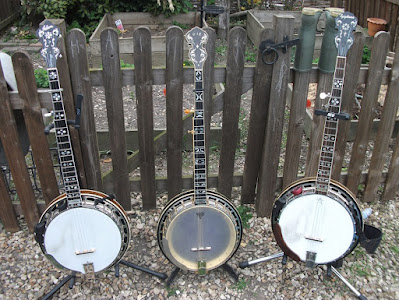
I've been mainly studying Dave Hum's style. Dave's 219 YouTube videos are a lifetime library of banjo lessons. I recommend converting all of Dave YouTube videos to MP4's and downloading them to your own computer. You never know what might happen to YouTube's servers with all the cyber-hacking going on nowadays. I also converted all 219 songs to MP3's and downloaded them to my MP3 player, which I listen to in my car when driving, to study how Dave articulates his playing. I cherish Dave's music. By God's grace, he doesn't have a bigger fan than me! The first time I heard Dave Hum play the banjo in 2018 was his song, “Ballad Of Jed Clampett,” which made me weep. I had never heard the banjo played that way.
If you enjoy playing along with backing tracks like I do, I highly recommend buying the program MixCraft. This software allows you to change tempo and keys for a song. I often need to slow a backing track or song down, so I can learn and play along with it at my own speed. MixCraft allows you to easily do that. Like Dave Hum, I enjoy playing in the key of A on the second fret with a capo. Most songs for banjo are made in the key of G. If you only want MixCraft to do these things, the Basic Studio Version ($79) is more than enough. But if you want to make your own backing tracks, like I am doing, then I strongly recommend getting the Pro Studio Version ($149). Unlike other Digital Audio Workstations (DAW's), MixCraft is priced extremely reasonable.
I bought a new Fender Mustang bass several months ago to make backing tracks, but have since learned that using MixCraft's included MIDI bass has actually worked better for my needs. The MIDI bass sounds realistic enough for making basic backing tracks. So, even if you don't play bass guitar, you can use MixCraft to generate all your percussion, piano and bass sounds digitally. I think that is so cool. My heart's desire is to play the banjo, and I only make backing tracks for that purpose. I hope that you're enjoying the backing tracks I've made, as much as I have enjoyed making them to freely share with everyone. Music makes the world a better place! God bless you friend.

Gibson ESS, Baldwin Ode, Gibson Epiphone
Wednesday, May 15, 2024
“The Session Book” Banjo Course By Sean Ray
I found this nice banjo course today by Sean Ray for $45. Best of all, it comes with some quality backing tracks played by real musicians, not BIAB. I ordered the course and am pleased with it. I've been working on Foggy Mountain Special just now, which I recognized right away as one of the songs Dave Hum recorded. Dave does some great things in this song. It's a fun song to play.

In this e-course you get tablature in both .PDF and .TEF format, and then backing tracks with and without the banjo (which you download from Google drive) for the following 26 songs:
- Blackjack
- Bugle Call Rag
- Clinch Mountain Backstep
- Cripple Creek
- Cumberland Gap
- Dear Old Dixie
- Earl’s Breakdown
- Farewell Blues
- Fireball Mail
- Five Speed
- Flint Hill Special
- Foggy Mountain Breakdown
- Foggy Mountain Chimes
- Foggy Mountain Special
- Ground Speed
- Home Sweet Home
- John Hardy
- John Henry
- Lonesome Road Blues
- Pike County Breakdown
- Randy Lynn Rag
- Reuben
- Sally Ann
- Sally Goodin
- Shuckin’ The Corn
- Train 45
Good stuff! If you check online for the going average cost to pay someone to make you a backing tract, it is now $150 per song. Great fluffy biscuits in the morning! So, here you're getting 26 great backing tracks with violin, mandolin, guitar and bass for just $45, plus all the tablature.
The musicians are:
- Sean Ray – Banjo, Guitar, Bass
- Brian Ray – Mandolin
- Paul Kienitz – Violin
That's a great deal if you ask me! I don't get anything for promoting other people's stuff, I just like sharing things that help to enrich other musicians.
Also, on a different but related note, I love the program MixCraft and have used it for over 10 years to work with backing tracks and record my music. I use the Pro Studio version of MixCraft for $149, but I'm sure I could easily get by with the cheaper version. I've always had the philosophy that it's better to have it and not need it, than need it and not have it. If you do opt to buy the less expensive basic version, you can always upgrade for a discounted price at a later time to the Pro Studio version if you want. With just the lower priced $79 version you can edit any backing track to change it's tempo, key, add effects, et cetera.
For example: I really like the song Ground Speed. Sean Ray made an awesome backing track for it in his The Session Book course, but I wanted to speed it up a bit (it's one of a few songs I can play at a faster tempo), so I used MixCraft to make it a bit faster today. If you do purchase MixCraft and have any questions, I'll do what I can to help you. There's plenty of helpful information and tutorials online for the program, which is invaluable. Plus MixCraft has good tech support. Once you buy the program, it's yours for life. I like that. I hate the Microsoft wants to charge you every year to use their software. I try to avoid those traps.

A Cool Dave Hum T-Shirt I Had Made
Monday, May 6, 2024
Banjo Lick Of The Week Series
I found this helpful web page by John Boulding with some great banjo licks...
Banjo Video Lessons by John Boulding
This is a really great lick that can be implemented in your playing...
LOTW - Banjo Lessons: Useful licks - A low-position Scruggs lick
I'm having fun learning new licks and playing along with Dave Hum's backing tracks. I am so thankful to Dave's family for sharing these with the world. I hope they'll make many more available. They are worth more than gold to me as a home musician. I am working on making some more backing tracks of my own. I want to make one for Peaches & Cream by Alan Munde. I really like that song. Lord willing, if I do make it, I'll share it with everyone. My neck alway hurts, and I have Peripheral Neuropathy (burning nerves, numbness, radiating arm pain, et cetera), which makes it difficult for me to do anything. One day at a time.
Banjo Ben Clark did a wonderful job playing this song. I really like Ben. A couple years ago, I signed up for 6 months of his monthly banjo lessons. It was only about $25 per month. GOOD STUFF!!! Ben's got some backing tracks also, which is the main reason I signed up. I won't sign up for any lessons that don't include backing tracks, which I need to motivate me. Alan Munde has some tabs for sale on his website, but there are no backing tracks, which is unfortunate.
I am surprised that the BanjoHangout has so little in the way of backing tracks. The one's that do exist are nearly all junky computerized tracks. I was looking in the forum this evening for Earl's Breakdown (I really like that song), but there is no backing track for it. Lord willing, I want to make a track for that song. To play the song correctly, you need a Keith D tuner, or Cheat-A-Keys (to lower string 2). It is a classic favorite Bluegrass song.
I just paid a guy (who makes backing tracks for a living) to make me a backing track for Gaspe Reel the way Dave Hum played it. Dave used the Double C tuning, one of my favorites. When I receive the backing track in a couple weeks, I will share it freely with everyone. So, please come back and visit every so often.
By the way, I really appreciate everyone's interest in my BanjoHeaven blog. I'm a born-again Christian (since age 13 in 1980), so I thought "BanjoHeaven" was an appropriate name for my blog. I just love the banjo, love music, care about people and desire to create and share stuff to encourage, inspire and help other banjo enthusiasts enjoy the instrument more. My main instrument is the steel guitar, so pursuing the banjo is new and exhilarating to me. I'm having a lot of fun learning. Dave Hum is my main inspiration.
I want to record some banjo videos, but I am still learning and working toward it. I just ordered a Hatfield Buck Creek banjo last month. Arthur was very kind when I emailed him. He told me that his wife recently passed away. I shared with him that my wife divorced me in 2006, and I have lived alone and lonely for the past 18 years. He actually expressed empathy and said he hoped that I find a wife. I thought that was sweet of him to care. I'm glad that he is building me a banjo.
Most banjo makers use a CNC machine to make their necks, but Arthur makes all his necks by hand. I really like that. I had originally ordered a Deering Golden Era from Banjo.com in 2022, but that turned into a gigantic nightmare and I never got the banjo. It took me 20 months to get my $4,899 back. I will never buy anything from Banjo.com again! What a horrible place.
From all the reading I've done, I don't think I can go wrong with a Hatfield banjo. I've never read even one negative comment about Arthur or his banjos. So far I am well pleased with doing business with Mr. Hatfield. He said I should get the banjo in about 4 months, but I sincerely told him to take his time. I'll let you know when it arrives, take some pictures and Lord willing, record a song.
I'm working on Mason's Apron now as played by Dave Hum. I love that song. I can only play it at about 70% speed, but I like it slow. YouTube allows you to change the playback speed of videos, which is helpful. I have Dave's backing track for Mason's Apron, which is awesome! I sure hope Dave's family release more backing tracks. If you haven't purchased the 40 now available, I encourage you to get them while you can. You won't be disappointed. They are really great!
That's it for now. God bless.
Sunday, September 18, 2022
Learn Don Reno's Banjo Style Of Playing
I found something new and very helpful this week. His name is Jason Skinner and he is without question the most avid Don Reno fan in the world. I really love what Jason has done to help banjo players. He has recorded an 18-part superb set of banjo instruction lessons for banjo enthusiasts. The first video covers basic information, but in the following videos Jason gets into some excellent banjo stuff...
Beginning Don Reno Style Banjo with Jason Skinner - Part 1
I really appreciate when banjo artists share what they've learned with others. I give everything I learn away for free, and always will. I'm not putting down musicians who sell stuff, I get it, they need to eat. But there's just an excellent spirit (like Daniel had in the Bible), when musicians share what they've learned for the pure love of music. Daniel 6:3, “Then this Daniel was preferred above the presidents and princes, because an excellent spirit was in him; and the king thought to set him over the whole realm.”
By the way, my favorite lesson in Jason Skinner's awesome banjo series is part 13, a song written by Don Reno called: “I'm Using My Bible For A Roadmap.” There's some really cool banjo fills and licks in here. Also, you can find free karaoke backing tracks on YouTube for this song...
“I'm Using My Bible For A Roadmap” (written by Don Reno)
It is my desire to help other banjo enthusiast, sharing the things that I learn. I'm spending a lot of time in the woodshed workshop picking, getting better and learning my banjo. God willing, I plan to make some YouTube videos down the road. But for now, it is exciting to learn and share! If you haven't watched Jason Skinner's Don Reno YouTube lessons yet, I really think you'll enjoy them. God bless!

Wednesday, April 27, 2022
Awesome Jay Buckey Banjo Course
Jay Buckey's music is a blessing to thousands of musicians. I was sad to see his website vanish. Thankfully, I saved all of Jay's banjo resources while they were still available.
Here is his first course for the banjo...
- Tablature Book
- Blackberry Blossom | 100 bpm - Solo 1 | 100 bpm - Solo 2
- Boil The Cabbages | 100 bpm - Solo 1 | 100 bpm - Solo 2 | 150 bpm
- Cripple Creek | 100 bpm - Harmony | 100 bpm - Solo 1 | 100 bpm - Solo2 | 100 bpm - Solo 3 | 100 bpm - Solo 4 | 150 bpm - Solos 1 & 2 | 150 bpm - Solos 3 & 4
- Eight More Miles To Louisville | 100 bpm - Solo 1 | 100 bpm - Solo 2 | 150 bpm
- Exercises In Picking
- Feud In Five Strings | 100 bpm - Solo 1 | 100 bpm - Solo 2 | 150 bpm - Solo 1 | 150 bpm - Solo 2
- Good Night Ladies
- Kentucky Waltz
- My Home Across The Blueridge Mountains | 100 bpm | 150 bpm
- Rollin In My Sweet Baby's Arms | 100 bpm | 150 bpm
- Wabash Cannonball | 120 bpm
I miss Jay and hope he is well. Let's keep him in our prayers. What a cool guy!

Jay Buckey
The first time Jay Buckey's website was available, I had only purchased his banjo courses. I was so regretful when I saw his old website disappear overnight, literally. I play bass, banjo, mandolin, dobro and guitar. So Jay's courses are worth gold to me, priceless. Thanks Jay!
Subscribe to:
Posts (Atom)
5 String Banjo Instruction [1967] - Earl Scruggs
5 String Banjo Instruction Album [1967] - Earl Scruggs

-
 I have done my best to recreate several dozen of Dave Hum's backing tracks. I share them FREELY for the pure love of music . My only mo...
 -
 “Salt Creek” is a fiddle tune that was popularized by Bluegrass legend Bill Monroe (1911-1996). The tune is a Bluegrass staple that originat...
 -
 Here's a list of all the backing tracks I've made so far (a new backing track is added every Friday). Please download them all, so y...